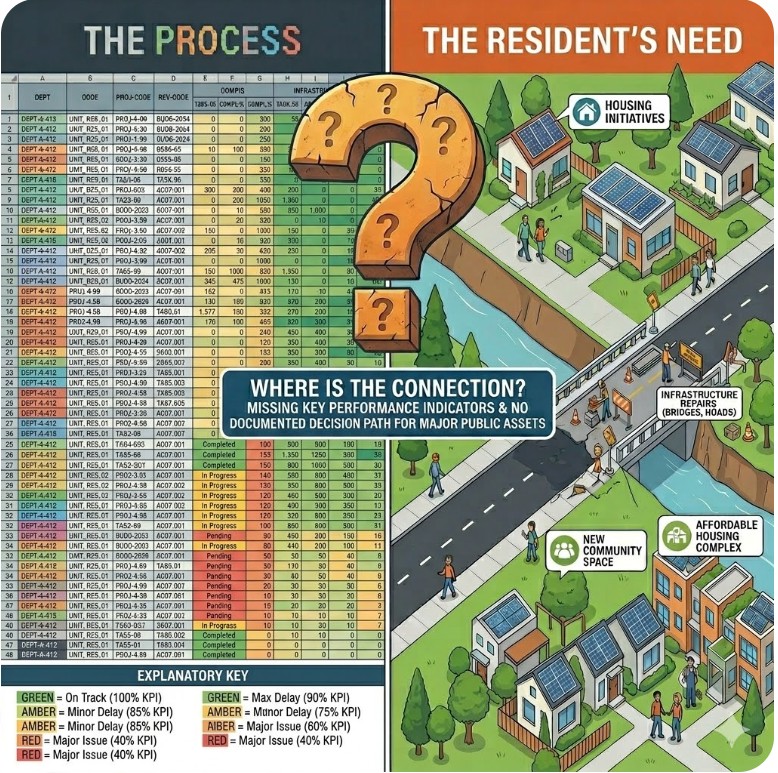
The February 2026 budget meeting was an exhausting marathon where minor operational tasks, like an Easter Egg Hunt, were given the same weight as critical bridge repairs. With no materials provided in advance and a complete absence of Key Performance Indicators (KPIs) to measure success, the process lacked the basic elements of responsible project management
The budget review process lacked clear prioritization and was structured around a sequential walkthrough of more than 200 items organized according to MODS’ internal departmental structure rather than by resident‑centred priorities. This approach obscured what matters most to the public and made it difficult to distinguish strategic issues from routine operational tasks.
The eight‑hour meeting format (8:30 a.m. to 4:30 p.m.), which relied on reading each line aloud from a spreadsheet, was not conducive to meaningful engagement or informed decision‑making. Extended sessions of this nature are widely recognized as ineffective for sustained attention, and the format discouraged thoughtful discussion. Compounding this, no materials were circulated in advance, limiting participants’ ability to review the information, reflect on implications, or prepare substantive questions.
Given that the budget spans four years, with projections extending to 15 years, the level of detail presented was unrealistic and operationally impractical. It remains unclear where the requirement for a 15‑year projection originated; such precision over that timeframe borders on the unreasonable.
A more effective process would have incorporated structured grouping and prioritization, such as organizing items by cost magnitude, risk level, or strategic importance. Instead, minor operational items (e.g., the Easter Egg Hunt) were discussed in the same manner and sequence as major capital expenditures (e.g., bridge repairs), diluting focus and diminishing the value of the discussion.
Overall, the absence of prioritization, the excessive meeting length, the item‑by‑item presentation format, and the lack of advance materials significantly limited the usefulness of the process and hindered productive outcomes.
What Should Have Happened
The meeting should have focused first on high‑cost, high‑risk, and high‑impact items—the decisions that shape the municipality’s long‑term financial position and directly affect residents. Items below a reasonable threshold (e.g., $10,000) should have been delegated to staff to manage within their operational authority.
Priority discussion topics should have included:
Major infrastructure needs, such as bridge repairs
Housing initiatives, including the HFA2 program
The municipality’s largest discretionary expenditures, particularly Hartz Point and the Highway 103 properties
Residents should have been placed at the centre of the process. All handout materials should have been made available well in advance, consistent with council meeting requirements. The hard‑copy spreadsheets provided lacked line numbers, yet presenters referred to line numbers – and several columns contained truncated text, making it difficult to understand what was being discussed. These avoidable issues created unnecessary barriers to participation and understanding. These issues reflect a broader pattern of poor planning for a meeting of such importance.
KPIs (Key Performance Indicator) – Where are they?
One of the primary reasons for attending the budget meeting was to assess the quality and completeness of the KPIs associated with each project. In the November 13, 2025 meeting, the CAO stated explicitly that a list of KPIs would be provided (see brief video here). After listening to all audio recordings of the budget meeting and reviewing the hard‑copy spreadsheets, it is evident that no such KPIs were included for any project.
The absence of project‑level detail is concerning. There are no milestones, no gating factors, no exit criteria, no deliverables and no KPIs—none of the basic elements required to manage projects responsibly or evaluate progress over time. Without these tools, the municipality risks defaulting to an implicit “whatever we achieve is success” mindset. That is not project management; it is the absence of project management.
The Strategic Plan prepared by Davis Pier provides a clear definition of a Key Performance Indicator (KPI): a measurable value that shows how well the municipality is progressing toward an objective. KPIs offer an objective basis for assessing progress and are fundamental to responsible project management. Without defined measures—milestones, gating factors, exit criteria, and KPIs—projects cannot be effectively monitored or evaluated. Again, when nothing is being measured, control is lost, and accountability becomes impossible.
Hartz Point and Highway 103 Properties
The purchases of the Hartz Point and Highway 103 properties represent two of the largest discretionary expenditures made by the municipality in recent years. Despite the scale of these investments, the public record shows that no clear plan existed at the time of acquisition. Shortly after the Hartz Point purchase, the CAO stated openly that there was no plan for the property (see this brief video), and Council did not question this. Following the acquisition of the Highway 103 lands, the same pattern repeated: the CAO again stated that there were no plans, and a consulting firm was subsequently hired to advise Council on what could be done with the property.
Yet at the budget meeting on February 26, 2026 - only four months later - multiple items appeared in the budget related to both Hartz Point and the Highway 103 properties, including LiDAR, surveys and marketing costs. Both the CAO and the Warden emphasized the urgency of preparing these lands for sale.
This raises fundamental questions about transparency and process:
How did the municipality move from “no plan” to an active project aimed at preparing the land for sale?
Where is the documentation that explains this shift?
When were these decisions made, by whom, and under what authority?
How and why were the new budget items added to what had previously been described as a “no plan” situation?
The absence of a clear, documented decision path for such significant public assets is concerning. It undermines public confidence and makes it impossible to understand the rationale, timing, or strategic intent behind these expenditures.
Conclusion
In summary, the February 2026 budget meeting demonstrated a fundamental failure in both process and accountability. The decision to conduct a sequential, all day walkthrough of more than 200 items without prior circulation of materials or clear prioritization made meaningful engagement and informed decision-making virtually impossible. By treating minor operational tasks with the same weight as major capital expenditures, the municipality diluted the focus on high-risk, high-impact strategic issues such as infrastructure repairs and housing initiatives.
Furthermore, the complete absence of Key Performance Indicators (KPIs), milestones, and deliverables—despite prior assurances—represents a significant lapse in responsible project management. Without these objective measures, there is no mechanism to monitor progress or ensure accountability for public spending. This lack of transparency is further exemplified by the shifting narratives surrounding the Hartz Point and Highway 103 properties, where significant public assets moved from having "no plan" to active budget items without a clear, documented decision path.
Comments
Add a Comment