While the Warden's budget statement serves as a political statement of intent, it must be supported by a rigorous project management methodology and predefined metrics to ensure that "transparency" is a reality rather than just rhetoric.
The budget process for 2026-27 has concluded. Previously, the municipality developed a Strategic Plan, conducted at least two surveys regarding that plan, held a public consultation with the Economic Growth Committee, organized several full-day budget sessions, and issued a budget statement from the Warden based on these activities.
Superficial Public Engagement
The public consultation process began with "dismal" participation in community meetings and online polls. Despite this low turnout, the Economic Growth committee verbally claimed they received "good feedback" without providing written results, measurable metrics, or documentation to support the claim. Furthermore, the presentation of survey data was misleading and disingenuous, using percentages (e.g., "30% of respondents") to mask the fact that only a handful of people participated. This suggests a process designed to "please" rather than to provide an honest assessment of community sentiment.
Vague Priorities and Unprioritized Line Items
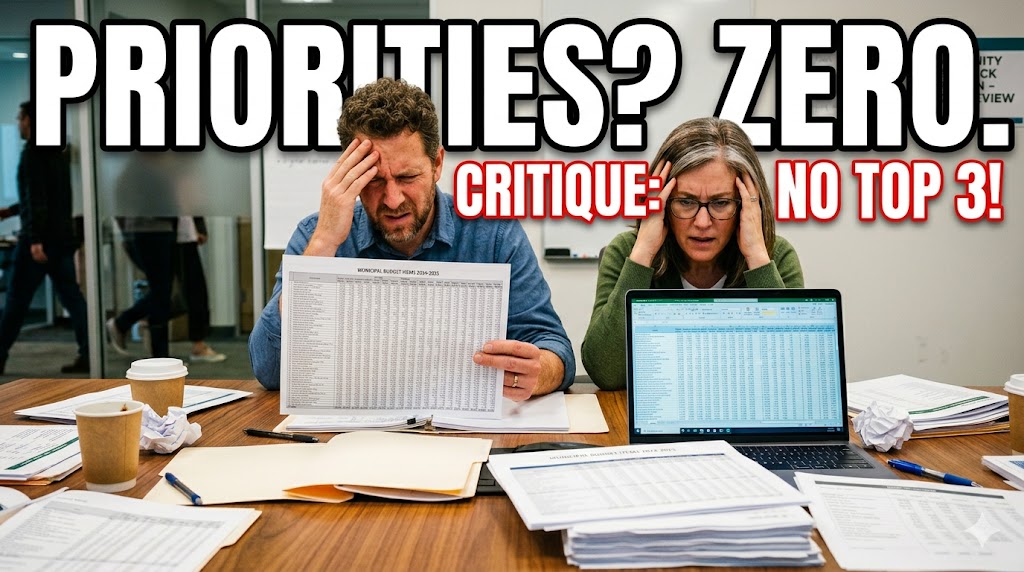
The Warden outlines five key priorities: Economic Development, Housing, Healthcare, Infrastructure, and Governance. While these sound strategic, they contrast sharply with the actual budget structure, which consisted of approximately 200 items presented in no priority order. This makes it impossible for residents to identify, for the top three discretionary projects funded by the $15.4 million budget. The budget statement focuses on the "what” but lacks the "how" or "why" regarding many items in the budget.
Process Inefficiency
The Warden introduced a "newly structured budget process" using a "Dynamic Economic Model," though its benefits remain unclear. Council insisted on reading every single line item aloud over multiple all-day sessions. This "priority free planning" prevented a high-level strategic review and instead bogged down the process in minutia, despite suggestions for more productive methods.
It remains challenging to determine which budget items are important and should be prioritized.
Absence of Accountability and Tracking
There is a concerning void where professional project management should be. The projects outlined in the budget spreadsheets do not adhere to a formal methodology or standardized template. As a result, written milestones, defined deliverables, clear timelines, and gating factors necessary for effective oversight are absent.
- KPI Shifting: While the budget statement promises "clear, accurate information", it omits the CAO's changing statements on Key Performance Indicators (KPIs), which shifted from being a budget deliverable to something that would be provided only "as projects unfold." (See this brief video showing this shift.)
- The Project Void: There is no mention of a defined "project" process or a documentation trail, leaving residents with no way to track the progress of the initiatives mentioned, such as the Jordan River Trail Bridge.
Rhetoric vs. Documentation
The Warden emphasizes "transparency" and "informed decisions", but the process lacked measurable metrics. The budget statement functions more as a list of "noteworthy items" and broad goals rather than a transparent financial roadmap that allows for public oversight of the $1.37 million capital budget.
Conclusion
While it is recognized that the Warden’s address serves as a political statement of vision and intent, such high-level priorities must be backed by a rigorous and standardized project management methodology to be meaningful to the community. To move beyond the current "priority free planning," the administration must provide the professional structure required to track projects and ensure that political promises are matched by procedural accountability.
Be the First to Comment
Add a Comment